

The messaging API you go with has a big impact on your company’s communications.
It affects how much you pay, how many of your texts actually land, and which apps you can use to reach your customers. Worries about “Why did that code not arrive?” are unnerving for any business owner.
I work with messaging tools a lot, and three names come up again and again: Twilio, Telnyx, and SMS.to. All three can send SMS and other types of messages, but they do it in different ways and at different price points.
Twilio is the big CPaaS provider that almost everyone has heard of. Telnyx is a newer rival that runs its own network. SMS.to is an agile platform that focuses on multi-channel messaging (SMS, WhatsApp, Viber, Telegram, RCS) with developer-friendly tools.
In this guide, I walk you through the 3 options and give you enough information so that you can pick the right provider. We will go over:
- How SMS.to, Twilio, and Telnyx stack up on APIs and developer experience
- How their channel coverage affects where and how you reach your users
- How delivery performance, compliance, and support shape reliability
- How pricing and global reach impact your monthly bill and growth plans
API coverage and ease of use
When selecting a messaging API, you want to know, “Will this be a headache or can I ship fast?” Here is a feel from a developer point of view:
Twilio
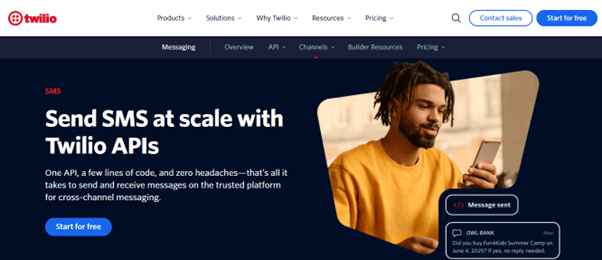
Twilio has the biggest set of APIs. You can use it for SMS, voice calls, email through SendGrid, video, chat, and more.
Its Programmable Messaging API is well written and has quickstart guides in several languages. Developers like the docs and the helper libraries, and I agree, they are easy to follow when you send your first test SMS.
The flip side is that this wide feature set can feel a bit heavy. You may need to set up messaging services, phone number routing, and other pieces before you use the advanced features. For basic SMS though, Twilio keeps things simple. You hit their REST API with a quick HTTP POST, drop in your To, From, and Body, and the text goes out.
Twilio also has a Lookup API for phone number details and a Verify API for OTP and 2FA codes. That means a lot of common flows are ready for you without much custom logic.
Telnyx
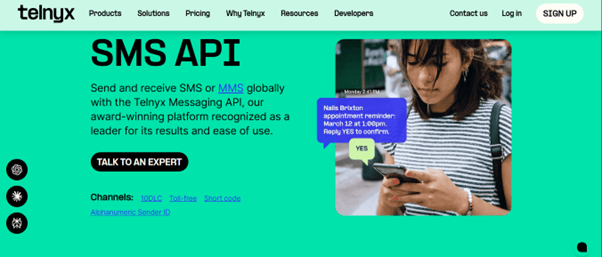
Telnyx covers similar ground for communications. You get APIs for SMS, voice, fax, and even wireless services. They are known for being developer-centric with detailed docs and SDKs in at least five languages (Python, Node.js, Ruby, PHP, .NET). If your team codes in different stacks, this helps you keep things consistent.
The Messaging API is intentionally close to Twilio’s style. Telnyx even built a “Twexit” mode, where you keep using the Twilio API format but send through Telnyx. Teams find it easy to switch from Twilio through Twexit API since it only requires small code changes.
You also get Mission Control, their portal for managing messaging profiles and phone numbers. With webhooks for delivery reports and inbound texts, you can watch what is happening in real time from your app. For most teams, the API feels strong and quite friendly, especially if you come from Twilio.
SMS.to
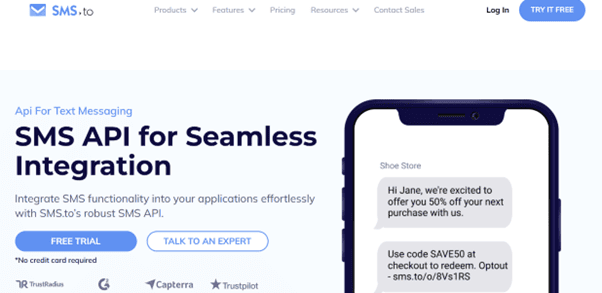
SMS.to takes a “keep it simple” approach. It focuses on messaging and makes it very quick to plug into your product. If you want to get live fast, this matters a lot.
You get a unified SMS Gateway API over REST and separate APIs for channels like WhatsApp and Viber on the same platform. Sending an SMS is as simple as an HTTP POST to api.sms.to/sms/send with a small JSON body. No long setup steps.
The docs give you copy-paste code samples in cURL, PHP, Node.js, Ruby, Python, Java, and Go. I see many teams go from “reading the docs” to “sending live test SMS” in minutes because of this. It shows a real focus on making developers comfortable.
SMS.to also supports webhooks for status callbacks (so your application can receive delivery receipts). If you send at very high volume or work with older systems, you can use SMPP as well. That keeps it open to both modern and legacy setups.
One thing I like is that some “extra” features are already built in. You can switch on automatic opt-out handling, and you can track clicks with short links. That means less custom code for your team to maintain. It also makes it easier to add flows like OTP, alerts, or bulk messages inside your app.
Verdict
All three providers give you solid APIs. Twilio covers the widest range of channels and features, which is useful if you see yourself adding voice, email, or video later. It’s battle-tested for a broader array of communication APIs beyond SMS.
Telnyx and SMS.to focus more tightly on messaging and voice, so they feel leaner. Telnyx is a good fit if you are coming from Twilio and want a similar API style with that Twexit mode and official SDKs.
SMS.to stands out if you care about moving fast and keeping your codebase light. You can send your first messages in minutes using their samples, and you get handy features like opt-out handling and short links in the same API. If you want an easy start with room to grow across SMS and chat apps, SMS.to gives you a very friendly path.
Channel support for SMS, apps, voice, and email
When you choose a platform, you’re really choosing where you can reach your users. Text only, chat apps, voice, email…the whole range.
Here is a quick view of how SMS.to, Twilio, and Telnyx compare across the main channels:
| Channel / Service | SMS.to | Twilio | Telnyx |
|---|---|---|---|
| SMS messaging | Yes ✅ | Yes ✅ | Yes ✅ |
| MMS (media messaging) | No (focus on chat apps / OTT*) | Yes ✅ (US & CA) | Yes ✅ (US & more) |
| WhatsApp Business | Yes ✅ | Yes ✅ | No ❌ |
| Viber Business | Yes ✅ | No ❌ | No ❌ |
| Telegram | Yes ✅ | No ❌ | No ❌ |
| RCS | Yes ✅ | Yes ✅ (available via API) | Yes ✅ |
| Voice calling API | No ❌ (messaging-focused) | Yes ✅ | Yes ✅ |
| Email API | No ❌ | Yes ✅ (via SendGrid) | No ❌ |
*OTT = over-the-top chat apps such as WhatsApp and Viber.
As you can see, SMS is standard. All three can send and receive texts. Twilio and Telnyx also support MMS in markets like the US and Canada, so you can send images or other media in a single message. SMS.to does not have a separate MMS product. Instead, it leans on chat apps for rich content.
Now let’s talk about chat apps, since that is where a lot of users spend their time. SMS.to supports WhatsApp, Viber, Telegram, and RCS from one platform. If you work in regions where Viber is huge, or you want Telegram alerts from a bot, that can be very handy. You do not need to glue different tools together.
Twilio supports WhatsApp (as an official BSP partner) and RCS, but it does not have Viber or Telegram built in. Telnyx supports RCS along with SMS and MMS, but it does not offer WhatsApp or Viber as native channels. So if your main goal is to use several chat apps besides SMS, the mix from SMS.to will stand out.
Voice and email are a different story. Both Twilio and Telnyx provide voice call APIs and can support VoIP or SIP, which is useful if you need phone calls, IVR menus, or contact centre flows. Twilio also owns SendGrid, so you get a full email API stack there as well.
SMS.to, on the other hand, focuses on messaging. It does not run its own voice or email APIs. The parent company can link you to voice or SIP services if you need them, but the main product is built around mobile messaging and chat apps. Some teams prefer this kind of focus; others prefer to get everything from one place.
Verdict
So, which channel mix fits you best? It really depends on what you are building.
- If you care most about omnichannel messaging across SMS and chat apps, SMS.to gives you SMS, WhatsApp, Viber, Telegram, and RCS under one roof. That suits use cases like ecommerce updates where you can reach customers on their favourite app.
- If you need voice and email as well as messaging, Twilio lines up with that need. Its extra products make sense for contact centres, support lines, and email-heavy products.
- If your focus is SMS, MMS, and voice, and you like a telecom-driven approach with RCS support, Telnyx is a solid option, even though it does not offer social chat apps.
There is no single “right” choice here. Look at the channels your users actually use today, and the ones you plan to add next. Then pick the platform whose channel list matches your roadmap most closely.
Delivery optimisation and performance

Let’s talk about the big worry you probably have in mind already. “Will my messages actually arrive, and will they be on time?” Deliverability is always the first thing teams ask me about when dealing with messaging tools.
Deliverability comes down to two things: How your provider’s network is set up, and how smart their routing is when something goes wrong. Twilio, Telnyx, and SMS.to all care about this, but they take slightly different paths.
Twilio
Twilio runs a huge global messaging setup (often called the Twilio Super Network). They connect to lots of local carrier partners in many countries. So Twilio works like a very large aggregator that plugs into many networks rather than owning every last-mile line itself.
In day-to-day use, this gives you wide reach. You also get tools such as Messaging Insights in the console and detailed delivery status callbacks with states like delivered, failed, or network unreachable. That helps you see what is going on with your traffic.
However, this model means that Twilio has to work with the carrier partners to fix deliverability problems when they appear. It uses the public internet and sometimes has to “lodge tickets with its middlemen” for routing issues. That can slow down fixes when messages are stuck.
On the positive side, Twilio provides tools like Messaging Services and Copilot. These can manage sender selection automatically for you and try things such as sticky routing or fallback between SMS senders. Like swapping to a backup long code if one route gets blocked.
They also provide a Notify service that can do multi-channel fallback across SMS, push, WhatsApp, and more, if you take time to set it up. Overall, Twilio’s deliverability is steady and proven at massive scale, but you are a step away from the telecom layer itself.
Telnyx
Telnyx puts delivery right at the centre of its story. It is a licensed carrier in 30+ countries and runs its own private IP network for communications. When you send an SMS through Telnyx, the message often travels across that private network into the telecom carrier, without going through a long chain of aggregators.
This design typically results in lower latency and fewer points of failure. Telnyx says this leads to faster fixes and higher quality, because their own engineers can trace message paths and adjust routing instead of waiting on third parties.
They report an average support resolution time of about 45 minutes for messaging issues. That number gives you a sense of how quickly they expect to close tickets. Their network also has multiple global points of presence, which helps keep round-trip times low for time-critical traffic such as OTP codes.
In many everyday cases, raw SMS delivery will look similar between providers. Where Telnyx can stand out is in edge cases, like tricky international routes or “grey” paths, because they can shift traffic through their own network in a more direct way.
Since Telnyx is a carrier, they can also support things like true local sender identity in regions where being the carrier of record matters. In short, they try to design the network itself around getting messages to the end user with as few hops as possible.
SMS.to
SMS.to does not run its own global fibre backbone, and it does not claim to be a carrier. Instead, it focuses on choosing direct carrier connections and premium routes to keep delivery rates high. The idea is simple. Avoid the cheapest paths that often break, and favour reliable connections instead.
On the platform, this shows up as an emphasis on “Global Delivery” through trusted partners. SMS.to works with tier-1 aggregators or carriers so that messages reach the local network with fewer detours. This matters a lot for time-sensitive traffic such as OTP codes or one-time alerts.
You also get tools that help you send smarter. For example, HLR number lookup lets you check if a number is valid and active before you send, so you waste less budget on dead lines. You can also configure sender IDs in countries where this is allowed, which helps with user trust.
One key feature I like is channel failover. If you start with Viber and the user cannot be reached there, the system can automatically fall back to SMS. You can also design flows that move between WhatsApp and SMS in a similar way. This extra redundancy can lift your overall delivery rate, because a message does not “die” when one app fails.
From a monitoring point of view, SMS.to gives you real-time status and clear logs. Their portal and APIs show delivery receipt states such as Delivered, Failed, Network Unreachable, and Unsubscribed for each message. Over time, this helps you clean your lists and improve future sends (e.g., if a number consistently fails, maybe it’s ported or inactive).
By combining direct routes, number checks, and multi-channel failover, SMS.to works to maximise the chance that your user sees the message somewhere, whether it is in their SMS inbox or in a chat app.
A quick example
Say you send a time-critical OTP code.
- With Telnyx, that code often travels over their private network with a short path into the carrier, and their team can see and fix issues with a high level of detail.
- With Twilio, the code goes through a very large global platform that handles billions of messages, with routing and retries mostly handled for you in the background.
- With SMS.to, the code might first go by Whatsapp/Viber, and if the chosen app is not reachable, it can fall back to another channel such as SMS, still using premium routes.
All three care about delivery. They simply express that care in different ways.
Verdict
Each provider supports standard features such as delivery tracking through webhooks and status callbacks. No one can fully avoid carrier-level problems or spam filters, because those sit outside any one company’s control.
Telnyx leans on direct network control and carrier licences to tune performance and troubleshooting. SMS.to leans on multi-channel logic and premium routing to raise your chances of a successful delivery across SMS and chat apps. Twilio leans on its scale and broad infrastructure, supported by best-practice guidance and built-in tools in the console.
Your choice here should match how you send. If speed of troubleshooting and direct carrier access matter most, Telnyx may appeal. If you want smart failover across several channels, SMS.to stands out. If you value huge global scale and a wide set of tools in one account, Twilio fits that picture.
A2P compliance support

Let’s talk about the “rules side” of messaging for a moment.
When you send Application-to-Person (A2P) traffic, you deal with things like US 10DLC, sender IDs, opt-outs, GDPR, and country-specific rules. I know it feels like admin work, but it protects both you and your users, so it is worth getting right.
When comparing Twilio, Telnyx, and SMS.to for clients here, I look at two things: How clearly they explain the rules, and how much they help you follow them without turning it into a full-time job. All three can get you compliant, but they guide you in slightly different ways.
Twilio
If you send SMS to US numbers on long codes with Twilio, you must register for A2P 10DLC. This is an industry rule and Twilio enforces it strongly. Unregistered traffic is filtered very hard or cannot go through at all.
Twilio’s Trust Hub walks you through:
- Registering your Brand (your company)
- Registering your Campaign (how you plan to use messaging)
Twilio passes through the Campaign Registry fees. You can expect around $4 one-time for brand registration and about $10 per month per campaign, plus the usual carrier fees. It is not free, but it is standard for US A2P traffic.
Twilio also publishes detailed country guides. You can see which sender ID types are allowed, when you need pre-registration (for example in India or UAE), and any content or rate limits. You get a lot of information, but you still need to follow the steps and keep track of forms and timelines.
For opt-outs, Twilio handles keywords such as “STOP” and “HELP” by default on many long codes and short codes. They send the correct reply and flag the number as unsubscribed, which helps you respect spam rules without extra code.
They also keep an SMS Compliance guide with notes on TCPA in the US and GDPR. Because Twilio is not the carrier in most countries, it has to follow local rules by asking you to register sender IDs and templates with local portals such as India’s DLT. In day-to-day use, Twilio gives you solid tools and documentation, but the process can feel a bit heavy if you are new to compliance.
Telnyx
Telnyx is a licensed carrier in many regions, and that changes how some parts of compliance feel. You still need to meet the same rules as everyone else, but Telnyx can often blend more of the work into its own portal and support process.
For US traffic, you still register for A2P 10DLC. Telnyx offers onboarding inside its platform and works with you to link your brand and campaigns to The Campaign Registry. Many teams find this feels more like part of setup than a separate project.
Their Trust Center and docs explain country rules such as when you can use alphanumeric sender IDs or when template registration is required. If you want a branded sender in the UK or need templates approved in India, Telnyx shows you how to do that against their numbers.
Because Telnyx controls numbers directly as a carrier, it can offer more local number options and supports toll-free verification in the US and Canada. Verified toll-free traffic is usually treated more kindly by carriers, which helps with long-term deliverability.
One thing to note: platform-level opt-out handling is less automatic. Telnyx gives you full access to inbound messages, so you usually build your own logic with webhooks to catch “STOP” and similar words, then update your internal lists. You get freedom and control, but you carry more responsibility in your own code.
SMS.to
SMS.to is based in the EU (Cyprus) and was designed with privacy and global rules in mind from the start. That EU background shows up in how it treats consent, opt-outs, and data logging. If you care a lot about GDPR and clear records, this can be very helpful.
You get built-in tools for opt-in and opt-out management. Through the API or the dashboard, you can manage contact status. When a user unsubscribes, messages to that number are blocked or flagged as “UNSUBSCRIBED” in the logs. SMS.to also encourages double opt-in and gives you methods to set it up without complex custom flows.
From a GDPR view, SMS.to is compliant and also helps you stay that way. You can log user consent, keep proof that someone agreed to receive texts, and store audit logs of what you sent and when. If you ever need to show this to regulators or internal compliance teams, those records are very useful.
For US messaging, SMS.to also follows the A2P 10DLC rules. Their docs and support team explain how to register your Brand and Campaign in The Campaign Registry. Instead of a self-service hub like Twilio’s, you often work more closely with support, which some teams prefer when they do this for the first time.
They also guide you through other regional systems such as India’s DLT (Distributed Ledger Technology). You can work with SMS.to to set up your Entity ID and template IDs so your messages reach Indian numbers in a compliant way. In some markets, SMS.to also respects things like quiet hours and national rules, while still expecting you to keep your own policies clean.
Verdict
All three providers can get you compliant; they just offer different “styles” of help.
- Twilio gives you the most extensive documentation and a formal, structured process, along with the related fees and forms.
- Telnyx uses its carrier status to make compliance feel more integrated into the platform and number management.
- SMS.to leans into built-in tools such as opt-out lists, consent logs, and GDPR-focused features, so you are less likely to trip over spam or privacy rules.
No provider can skip the rules for you. You still need user consent, proper registration, and good list hygiene. What changes is how much the platform holds your hand versus how much you script yourself.
Geographic pricing and reach

When you start sending SMS to real users in many countries, two questions hit you very fast: “Can I reach this country?” and “How much will this cost me each month?”
Let’s see how these providers fair:
Geographic reach
All three can send SMS to most of the world. The main differences show up in phone number options, network setup, and data location.
Twilio has one of the widest footprints for numbers. You can get local SMS-capable numbers in 100+ countries, and send messages to 180+ countries.It runs on a cloud setup with one main cloud provider and works with many telecom partners instead of holding local licences itself.
Telnyx takes a different route. It has points of presence across multiple clouds such as AWS, Google Cloud, and Azure, which adds extra redundancy. Telnyx is also a licensed telecom in 30+ countries and offers numbering in roughly 140 countries, covering most of the Americas, Europe, and APAC.
You may notice that Twilio’s catalogue of numbers includes some smaller markets that Telnyx does not reach yet. For most teams, though, Telnyx’s coverage is more than enough for typical global use cases.
Both Twilio and Telnyx can also offer local hosting options or regional data centres if data residency matters to you.
SMS.to is newer and focuses more on outbound messaging, and it shows country coverage on its service pages. You can send SMS from SMS.to to almost any country where SMS works. For two-way messaging, they offer long codes or short codes in selected countries and can arrange more options through their team.
Because SMS.to is part of Intergo Telecom, it still has telecom resources behind the scenes for global reach. In some markets, you may choose an alphanumeric sender ID instead of a local number, which is common for alerts and promotions.
Being based in the EU and hosted on AWS EU, SMS.to is also attractive if you care a lot about European data handling.
So, from a reach point of view, you can talk to users on all continents with any of the three. The nuance is whether you want lots of self-serve numbers, a carrier-led model, or a messaging-first platform with stronger EU roots.
Pricing models
Now to the money side.
All three use pay-as-you-go pricing. You top up, send messages, and get volume discounts as usage grows.
None of them force long contracts for basic messaging. Twilio and Telnyx do have enterprise deals if you want one. SMS.to also offers custom pricing when your volume climbs.
Twilio pricing
Twilio is often seen as a premium option.
In the US, it charges $0.0083 per SMS segment for both inbound and outbound messages. That is roughly $0.008 for a 160-character text.
US carriers also apply their own A2P fees of about $0.002 to $0.005 per message. Twilio passes those through, so the effective US cost can be around $0.0114 per message.
In some countries, especially certain African or Asian networks, prices can reach $0.05 or more per SMS.
Twilio also charges for inbound SMS in many cases. In the US, receiving a message on a long code is the same $0.0083 rate. Phone numbers themselves cost around $1 per month for a US long code, while short codes can run into hundreds of dollars monthly.
There are volume discounts. For example, when you send above 300k messages per month in the US, the rate can drop to $0.0079 per message. Very large customers can negotiate their own custom deals.
Many teams still find Twilio more expensive than other options for messaging. In some comparisons it comes out as 50% or more higher than rivals. Twilio also charges $0.001 for each failed message attempt, which can add up at scale.
Telnyx pricing
Telnyx presents itself as a cost-saving option.
In the US, it charges about $0.0040 per outbound SMS, to any carrier. Inbound SMS is $0, which is very useful for two-way conversations.
If you place it next to Twilio, you can see the gap clearly.
Twilio at $0.0083 vs Telnyx at $0.0040 makes Twilio roughly 2x the price per SMS in that market. Telnyx often undercuts Twilio on voice and numbers as well, with voice minutes around 40–50% cheaper and DID numbers at lower monthly rates.
Telnyx also builds in automatic volume discounts. As your usage grows, your rate goes down without needing a special contract. They often say customers can save 30–70% on communication costs after switching.
US numbers from Telnyx usually sit in the $0.25–$0.50 per month range, which is below Twilio’s standard $1. For international SMS, Telnyx tends to offer lower prices than Twilio in many destinations, but you still need to check your specific country list.
There are no monthly API fees; you pay usage and any number rental only.
SMS.to pricing
SMS.to also runs on pay-as-you-go and aims to be competitive, but the pricing is more tailored by country.
They have published an example base rate of about $0.022 per SMS. Actual prices by country can be downloaded from their pricing page.
Within Europe, you can expect many routes in the €0.02–€0.03 per SMS range. Some APAC or US routes might come out lower or higher. On first look, this can seem higher than Telnyx for markets like the US, where Telnyx is around $0.004.
However, SMS.to is very open to volume discussions. They highlight “No contracts, pay only for what you use” and invite high-volume senders to talk about better rates. They also run a “Fair Price Promise” where they try to match a lower price for the same service if you can show it.
In practice, many teams negotiate custom rates once their traffic grows. That means the “list” price you see on the website may fall close to, or match, rates from other providers for the same routes.
They also avoid extra charges for the API or standard support.
For inbound SMS, you usually speak to their team. Costs here depend on renting a virtual number or shortcode and may include a small fee per inbound message in some countries. That pattern is similar to many other providers.
Verdict
If you look at raw SMS rates, Telnyx is usually the lowest, especially in the US and often in other regions. Twilio tends to sit at the higher end and charges extra for some events, such as failed message attempts. SMS.to starts with mid-range public rates but often closes the gap through volume discounts and its Fair Price Promise.
To get started, SMS.to asks for an initial deposit to fund your account but no recurring commitment. Twilio and Telnyx also let you stay on full pay-as-you-go accounts. Free trials exist across all three: Twilio gives about $15 in trial credit, Telnyx often gives $10, and SMS.to offers free test credits with no card required.
Your best option depends on both price and what you need from the platform.
- If pure cost per SMS is your top concern and you send high volume, Telnyx is a strong benchmark.
- If you value a very broad product set and are okay paying a premium, Twilio fits that profile.
- If you want flexible pricing with multi-channel messaging and are ready to negotiate based on volume, SMS.to can come close to Telnyx while also offering extra channels and routing options.
It also helps to look at “total cost” rather than only the sticker price. Things like inbound fees, support charges, compliance costs, and number rental all play a role. Once you add those up, many teams find that Telnyx or a well-negotiated SMS.to deal delivers big savings compared with paying Twilio’s standard list prices.
Developer tools and migration readiness

If you are a developer, you care about how fast you can ship the first SMS. To start from scratch, you want great docs and simple examples.
When you already have live traffic, you also worry about “Will I break everything if I switch this API key? How painful will it be if I ever want to move to another platform?”
I’ve looked at Twilio, Telnyx, and SMS.to with those questions in mind. Let me walk you through how each one handles tools and migration.
Twilio
Twilio has been around the longest, and it shows in the size of its developer ecosystem. You get official helper libraries for Python, Java, C#, PHP, Ruby, JavaScript, Go, and more, along with mobile SDKs for apps. If you like learning from docs, Twilio gives you everything from “send your first SMS” to detailed guides for complex flows.
They also give you a CLI and Terraform support, so you can manage phone numbers and settings as code. That is handy when your stack is more “DevOps heavy” and you want repeatable setups across environments. On top of that, Twilio’s community is huge, with active forums, Stack Overflow answers, and many blog posts written by other developers.
The flip side is that Twilio has its own way of doing many things, such as TwiML and certain response formats. They somewhat ‘lock’ you in. Over time, your code can become very tied to that style. If you decide to leave later, you often have to refactor parts of your code and rethink number setups that only exist inside Twilio’s tools.
Twilio’s API style has quietly become a kind of “default” in this space. The good news for you is that many other providers copy that style, which makes moving a bit easier. But it is fair to say Twilio is strongest when you are starting fresh, and moving away later can feel like a project on its own.
Telnyx
Telnyx openly courts teams who might be moving from Twilio or another CPaaS. One of their most interesting tools is the Twexit API, which acts as a compatibility layer. You can point your app at Telnyx, keep using the same Twilio-like parameters, and in many cases your code will just keep working, now sending traffic over the Telnyx network.
This alone can cut migration time a lot, because you do not have to rewrite every single call on day one. Telnyx also provides its own REST API, docs, and SDKs, which are modern and easy to follow. Their Mission Control dashboard gives you clear logs and live views, which makes debugging during integration much less stressful.
For phone numbers, Telnyx built FastPort®, their porting system. Traditional number porting is slow and full of emails. Telnyx highlights that moving numbers out of Twilio can take ~3 weeks, and Twilio’s UI does not support every international port. With FastPort, Telnyx can often move numbers, even from Twilio, more quickly and give you real-time status updates.
If you rely on long-term numbers for two-way SMS or voice, that kind of smooth porting really matters. Telnyx also offers Postman collections, API auto-generators, and migration guides that walk through common patterns. Their sales and solutions teams will usually help map your code one-to-one, which I have seen save teams many days of trial and error.
SMS.to
As a newer player, SMS.to had to put a lot of emphasis on being easy to work with from the get-go. And it had the advantage of learning from older platforms. The team has put a lot of effort into making the first integration feel simple, even if you are not a senior engineer. The REST API keeps to clear JSON, and the docs show concrete examples that minimize the learning curve.
They provide quickstart guides and sample code for many languages, and they host SDKs or samples on GitHub. This means you can copy an example, drop in your API key, and send a test SMS in a short time. Developers often describe it as “copy-paste friendly” because you do not need to build a lot of glue code before you see results.
SMS.to does not offer a Twilio-compatible mode, but the structure is close enough that moving from Twilio rarely feels scary. For example, Twilio uses AccountSID auth, while SMS.to uses a simple Bearer API key in the headers, and the JSON structure differences are minor. Most migrations come down to switching the endpoint and adjusting a few field names.
For phone number migration, SMS.to does not yet have a self-service tool like FastPort, but they do support porting and setup through their team. If you are coming from Twilio, they will match your use case one by one. For example, if you used Twilio Verify for OTP, they help you map that to their Verify flows over SMS or WhatsApp. If you used Twilio short codes, they can provision a shortcode or advise using a sender ID instead.
Because SMS.to is smaller, the support style is more “hands-on.” They are happy to walk through your setup, which can be a real relief if you do not have time to become a telecom expert. Alongside the API, you also get a web dashboard where you can send campaigns, check logs, and see what your API is doing, which is useful for marketing or support teammates who are not writing code.
Integrations with other tools
You probably do not live in a messaging bubble, so integrations matter too. Twilio has a large marketplace of add-ons and hooks into CRM tools and other platforms. If you like building custom flows, their webhooks and APIs give you a lot of freedom to connect with your stack.
SMS.to has focused on messaging-led integrations. You will see things like a HubSpot SMS plugin or a WordPress plugin, which are handy if your team already works in those tools every day. Telnyx and Twilio both give you generic webhooks and REST APIs, so if you are comfortable coding, you can make them talk to almost anything.
Verdict
From a developer point of view, all three are very workable. Twilio shines when you are getting started and want rich docs, lots of examples, and a big community to copy from. Telnyx stands out when you care about migration and want a low-friction path away from Twilio, with tools like Twexit and FastPort to smooth the move.
SMS.to focuses on a quick ramp-up and friendly support. It gives you a simple API, clear examples, and real people to help you port numbers or swap over specific flows like OTP or short codes. That can be very calming if you are the only developer on the project.
If your fear is being “stuck” on one provider, both Telnyx and SMS.to try to ease that feeling in different ways. Telnyx leans on technical compatibility and faster number porting. SMS.to leans on pricing flexibility and high-touch help, so you do not feel forced to leave just to cut costs or get support.
Support and SLAs

When something breaks at 2 a.m. or a campaign goes weird, support suddenly becomes the most important feature. I always tell teams that tools are great, but how fast you get help on a bad day can make or break trust with your own customers.
So let’s look at how Twilio, Telnyx, and SMS.to show up when you need extra help and human intervention.
Twilio
With Twilio, standard support for free/pay-as-you-go accounts is relatively limited. They mainly rely on docs and community help.
You can open support tickets, but replies often come during business hours, and there is no guaranteed response time on the free tier. Many developers end up living in the docs, forums, or Stack Overflow when an error pops up.
If you want stronger support, Twilio sells paid plans. The basic plan starts around $250 per month, and higher tiers can reach $1,500 per month or 6% of your spend, whichever is higher, for 24/7 support with faster SLAs. It is not unusual for a team to pay around $18,000 per year just to get support “at the level” that comes as standard with some rivals.
Twilio does have a detailed status page and even a status API, which is helpful when there is a wider incident. Their standard uptime SLA is usually around 99.9% for APIs, with higher promises for some enterprise deals. But if there is an outage and you are on the free tier, your main option is to watch the status page and wait; proactive alerts and credits are usually tied to paid support.
Overall, I see Twilio as strong on transparency and documentation, but direct help can feel distant unless you are on a paid support plan or a very large account.
Telnyx
Telnyx takes a different approach and offers 24/7 support for all customers for free. You can reach them by live chat or phone at any time, which is very comforting when you are on call. Most of the time, you are talking to a network engineer or an expert directly (they don’t outsource it to a generic call center).
Because Telnyx owns and operates its own network, their support team can check routes, call quality, and message paths in real time. That tends to speed up troubleshooting a lot. They often highlight that they do not need to “chase” third-party carriers to look into issues.
Telnyx also helps with onboarding and setup calls, even if you are not a huge spender. Their uptime SLA is usually around 99.99%, backed by redundant, multi-cloud infrastructure. If they miss that SLA, they offer service credits.
A status page (Trust Center) is available, but they tend to have fewer widespread incidents due to the network redundancy (for instance, Twilio had a few notable outages in past years that impacted many customers; Telnyx’s multi-cloud approach is designed to mitigate single points of failure).
From what I have seen and from public stats like an average 45-minute issue resolution time, Telnyx puts a lot of energy into support quality. For teams running mission-critical flows, that kind of free 24/7 help is very reassuring.
SMS.to
SMS.to is smaller but also promises 24/7 support as a core part of the product. They also provide multi-lingual support, which can be handy if your team is spread across regions. You usually reach them via email or chat, and the tone is very personal and hands-on.
Because the team is more boutique, they often go deep into your specific case. If you ask about deliverability, they may pull your logs, check routes, and suggest concrete fixes for your content or sender setup. That level of attention would normally sit behind a high-tier plan at many larger providers.
SMS.to runs a support portal with FAQs and ticketing and has account managers for bigger clients. They also keep a public status page so you can check if there is a system-wide issue. The uptime target is generally around 99.9%, which is similar to other aggregators that rely on upstream carriers.
One thing I like is their proactive style. If they see many failures to a certain country, they might contact you first, suggest a different route, or flag a local rule. In serious cases, senior people, including CEO-level folks, are known to step in to sort things out. That kind of culture and level of attention creates a strong sense of trust.
Verdict
If support is high on your list, Telnyx and SMS.to tend to give you faster, more human help without asking you to buy a premium plan. Telnyx stands out with free 24/7 support, strong SLAs like 99.99% uptime, and clear stats such as an average 45-minute resolution time. SMS.to focuses on very customer-centric support, with a lot of personal attention and multi-lingual help.
Twilio’s platform is stable and well-documented, but the most responsive support is usually locked behind paid tiers. For small and mid-sized teams, that can mean slower replies during urgent issues, unless you are ready to budget for premium support on top of your usage.
From a continuity point of view, if you promise your own clients quick fixes and high uptime, having a free 24/7 line into Telnyx or SMS.to can make your life much easier.
Twilio, Telnyx, and SMS.to all offer credits and guarantees at the enterprise level, but the style differs: Twilio and Telnyx are more formal and contract-driven, while SMS.to tends to be flexible and pragmatic, often working with you one-to-one if an outage hits you hard. They would likely compensate or find a way to make it right (their ethos is to not be bureaucratic about these things).
Use cases and strengths of each provider
Each platform has carved out certain niches where it excels. Here’s how customer profiles play to the strengths of SMS.to, Twilio, and Telnyx:
Twilio – best for broad enterprise needs and ecosystem
Twilio works well when you want almost everything in one place. If you are building a big contact centre or a full engagement platform with SMS, voice, video, email, and chat, Twilio gives you a lot of building blocks, including Twilio Segment for customer data.
A large fintech or bank, for example, might use Twilio Verify to send OTP codes over SMS, voice, email, WhatsApp, TOTP apps, and even push – all from a single API. Very few providers match that kind of channel mix in one product, which is why bigger teams often start there.
Twilio Flex is also handy if you are running a contact centre and want SMS, WhatsApp, calls, and more in one support workflow. Some enterprises prefer that instead of stitching together several vendors. Twilio also tends to be early with new options like RCS business messaging or rich chat features.
Companies with large dev teams and budgets sometimes pick Twilio because it feels like a safe, known choice. Global ride-sharing apps, on-demand delivery services, and marketplaces have used it to launch quickly in many countries. Some later move away for cost reasons or reduce reliance on it (Uber is a classic example), but Twilio often helps them reach that scale in the first place.
If you need complex automation, Twilio Functions and Studio (a visual flow builder) can also help you create messaging workflows without hosting your own logic from scratch. So if your dream is a big, multi-channel setup with lots of knobs and dials, Twilio fits that picture well.
Telnyx – best for cost-sensitive and technical, communications-focused
Telnyx tends to shine when communications are at the core of your product and cost control is a top priority. These are the likes of SMS marketing platforms or CPaaS resellers who send millions of messages and need low rates to maintain margin. For them, Telnyx can often save 50%+ compared to Twilio on messaging costs alone.
It is also very attractive for telephony-heavy products. VoIP providers, call centres, and UCaaS platforms use Telnyx for SIP trunking, voice, and SMS in the same place. IoT and logistics firms like the private network and SIM offering, because they can track devices and send alerts over the same Telnyx stack.
Telnyx is a favourite for “Twexiters” – teams moving away from Twilio after growing to a size where bills start to hurt. Telnyx actively talks about those savings and provides tools to ease migration, which is why they end up high on the shortlist.
Security and fintech companies may also prefer Telnyx when they want more direct control over routing for sensitive messages. Since Telnyx is a carrier, there are fewer hops where data passes through third parties. And if you need programmable wireless (IoT SIMs) alongside messaging, Telnyx can cover that as well, often at a lower cost than similar products from Twilio.
So Telnyx fits teams that are developer-led, run communications as a core product feature, and want to tune cost and performance very closely. A call automation platform that sends follow-up SMS after calls is a good example; they can run both calls and texts through Telnyx, keep quality high, and still protect their margins.
SMS.to – best for multi-channel customer engagement with personal support
SMS.to is strongest when you care about SMS and OTT apps like WhatsApp and Viber, and you want a simple way to tie them together. I often see e-commerce stores, logistics firms, SaaS tools, and offline retailers adopt it for alerts and marketing campaigns.
For instance, an e-commerce platform might need to send order confirmations over SMS, delivery updates over WhatsApp with images or location pins, and promo campaigns over Viber where that app is popular. With SMS.to, all of that can sit behind one integration, which is easier for a small tech team to manage.
Another pattern is food delivery or ride-hailing apps using SMS.to to reach drivers and customers over SMS or Telegram. When you can mix channels, you raise your chances of catching people on the app they check regularly during their day.
For OTP and 2FA, SMS.to’s Verify API can try WhatsApp first, then fall back to SMS after a few seconds if needed. That kind of smart routing can lift success rates and, in some regions, even save costs by favouring the channel that works best locally. Fintech and e-banking apps serving tricky routes often find this helpful.
SMS.to also works well for small and mid-sized teams that find Twilio too complex or pricey and feel Telnyx is a bit too “telecom heavy.” These teams often want more guidance. SMS.to’s staff spend time understanding use cases – like a regional retail chain building an SMS loyalty club – and help design the setup end-to-end.
You also get very practical country advice, such as “use numeric sender IDs in country X” or “use WhatsApp templates in country Y to avoid filtering.” That kind of coaching can be useful if you do not have your own messaging expert.
Finally, the fact that brands like Heineken, Bolt, and AB InBev use SMS.to tells you it can handle both big campaigns and important alerts. A beer brand might use it for event invites over SMS or Viber, while a ride-share like Bolt uses it for time-critical driver and passenger updates. They are drawn to the mix of global SMS, OTT channels, cost-awareness, and direct support that does not feel distant.
SMS.to vs Twilio vs Telnyx – which one actually fits you?

All three can send your messages just fine. The issue is what you care about most. Is it features, price, support, or having everything in one place? I’ll walk you through how I’d help a team choose, so you can see where you fit.
Choose Twilio if you want a very broad toolkit
Twilio is a good match if you need one platform for almost everything. You can plug in SMS, voice calls, video, email, chat, and even customer data tools like Twilio Segment. If you are building a big contact centre or a rich engagement platform, that wide menu is very handy.
A large bank or fintech, for example, might use Twilio Verify to send OTPs over SMS, voice, WhatsApp, TOTP apps, and push from one API. If you also want to mix in Twilio Flex for contact centre work, or try channels like RCS early, Twilio makes that possible without juggling many vendors.
The trade-off is cost and support. Twilio tends to be the premium option, and very personal help often sits behind paid support plans. It is a strong choice for big enterprises that want a “one platform” approach, but smaller teams may feel they are paying for features they never touch and reading long docs for simple needs.
Choose Telnyx if you care most about cost and network control
Telnyx is a great fit if you send a lot of traffic and you watch your bill closely. High-volume SMS services, CPaaS resellers, and call-focused products like VoIP or contact centres often go here because they can save 30–70% versus Twilio on messaging. Over millions of texts, that gap really matters.
It also suits teams that are comfortable with the more “telecom” side of things. Telnyx runs its own network, offers strong voice and SIP trunking, and even has programmable wireless with IoT SIMs. A logistics company, for example, could use Telnyx for both device connectivity and SMS alerts under one roof.
The free 24/7 support and quick number porting are big perks when you run critical flows. On the other hand, Telnyx is focused on communications only. You will not find many built-in marketing tools or email services, so you should be happy wiring those up yourself.
Choose SMS.to if you want strong messaging and a supportive partner
SMS.to works best when messaging is the heart of what you do and you like the idea of SMS and chat apps living together. Think of e-commerce stores, logistics firms, SaaS tools, or retail brands that send order updates, delivery alerts, OTPs, and promos across SMS, WhatsApp, Viber, Telegram, and RCS.
With one integration, you can hit people on the channel they prefer. Maybe your customer gets an order confirmation over SMS, a rich delivery update over WhatsApp, and a promo on Viber where that app is popular. You do not have to stitch five tools together to make that happen.
Pricing is pay-as-you-go and meant to stay fair. You top up and send, and if you have volume, SMS.to is willing to match competitive rates so you are not overpaying. The focus is on clear costs rather than surprise add-ons.
What stands out most in my experience is the support style. SMS.to treats you like a partner, not just an ID in the dashboard. Whether you are a startup or an established brand, the team helps with routes, compliance, sender choices, and templates so that your campaigns actually land. Many companies that pick SMS.to mention how easy it was to integrate and how reassuring it feels to have a responsive team behind the product.
Some teams even mix providers. They may keep Twilio for one product and use SMS.to or Telnyx for another. But if you want one main platform to run SMS alerts, OTP flows, and WhatsApp or Viber campaigns with clarity and support, SMS.to often lands in that “just right” middle between Twilio’s broad but pricey stack and Telnyx’s very lean, cost-driven focus.
The key is to match the platform to your own priorities. Once you are clear on what matters most to you – channels, cost, control, or support – the right option usually becomes much easier to spot.
