
The 7 Best OTP API Providers
Below is a list of the best OTP API providers to consider, depending on your use case and team needs. Then, there is a full comparison between each company:
SMS.to — best overall for practical OTP delivery with multichannel support and simpler execution
Twilio Verify — best for highly customizable, developer-led verification workflows
Sinch Verification API — best for enterprise-grade global authentication
Vonage Verify — best for multichannel verification with strong fraud prevention features
Infobip — best for high-scale international authentication
Plivo Verify — best value-oriented OTP API for SMS, voice, and WhatsApp verification
Telnyx Verify — best for technical teams wanting more control and pricing transparency
1. SMS.to
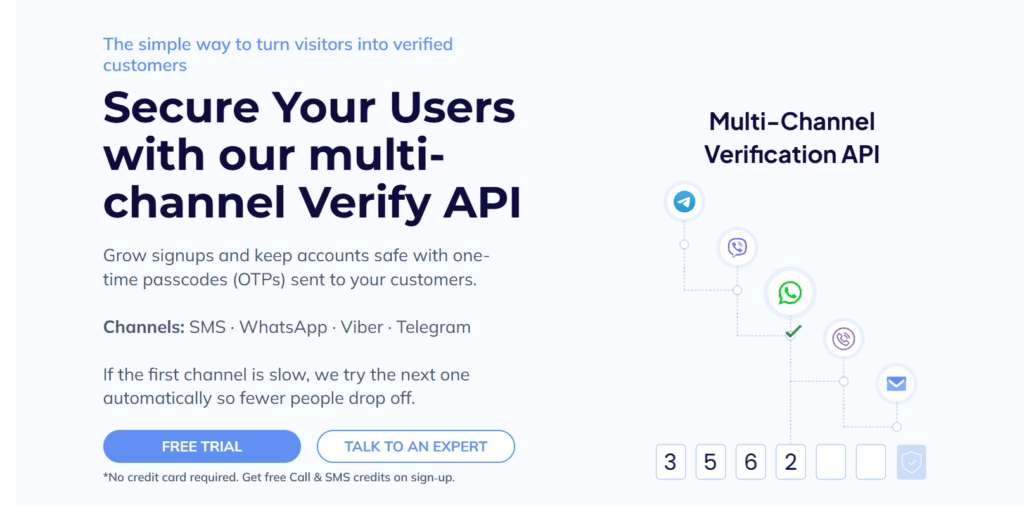
SMS.to is the best overall OTP API provider for businesses that want reliable verification without unnecessary complexity. It combines multichannel verification, flexible API access, and business-friendly workflows into a platform that is easy to implement and scale. Instead of focusing only on sending OTP codes, SMS.to is designed to help businesses manage the full verification flow, including retries, delivery tracking, and fallback logic across channels.
Key Features
Multichannel Verify API (SMS, WhatsApp, Viber, Telegram)
Configurable fallback logic between channels
Customizable OTP settings (expiry, retry attempts, validation rules)
Callback / webhook support for real-time updates
Delivery tracking and reporting
Team and sub-account management
Designed for both API integration and operational usability
Pricing
SMS.to uses a usage-based pricing model, where costs depend on destination and channel. This allows businesses to scale verification workflows based on actual usage without committing to rigid plans. As with most OTP providers, pricing varies by country and channel, but the structure is generally straightforward and aligned with real usage.
Pros and Cons
| Pros | Cons |
|---|---|
| Strong balance between simplicity and capability | Smaller brand awareness than major incumbents |
| Multichannel verification with fallback logic | Pricing varies by country and channel |
| Easy to implement and scale | Not positioned as a heavy enterprise platform |
| Business-friendly features beyond raw API | Some advanced enterprise features may require alternatives |
| Supports both technical and non-technical teams |
Reviews
The most efficient thing about using SMS.to was its easy to use APIs which helped us in fast and easy integration along with easy to use dashboard to send automated SMSs. Another thing is its strong documentation and tech and support teams’ readiness to help as and when required. G2 Review
Easy to setup and integrate with a business process. Can send notifications of orders or other events that can be triggered from the schedulers of other software you now use. Capterra Review
2. Twilio Verify
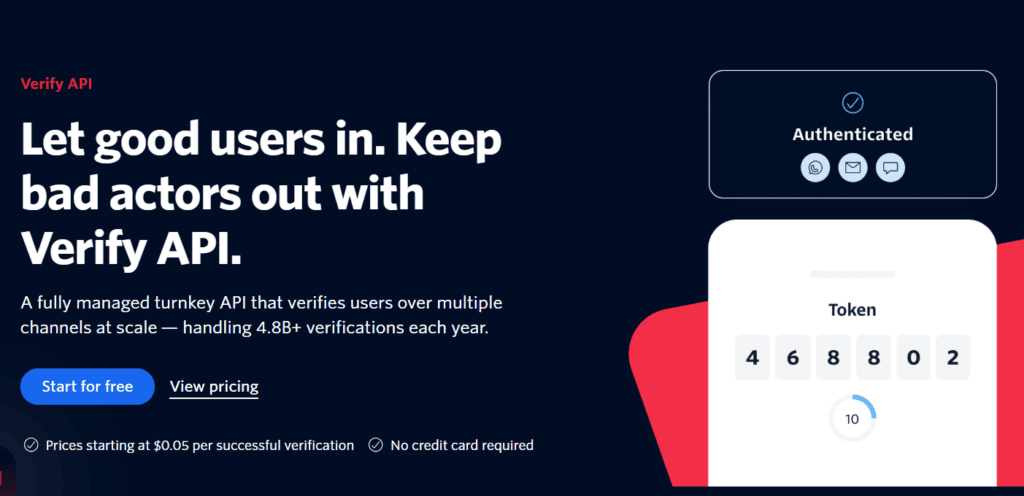
Twilio Verify is one of the most widely used OTP APIs, especially among developer-heavy teams that need full control over authentication workflows. It is part of Twilio’s broader communications platform and is designed to handle verification at scale, with built-in support for multiple channels, global delivery optimization, and advanced configuration options.
Key Features
Multichannel verification (SMS, voice, WhatsApp, email, push)
Fully managed OTP workflows (code generation, validation, retries)
Global delivery optimization
Rate limiting and fraud protection features
Extensive SDKs and developer tools
Customizable verification logic and flows
Scalable infrastructure for high-volume use cases
Pricing
Twilio Verify typically uses a per successful verification pricing model, plus additional costs depending on the channel used (SMS, voice, WhatsApp, etc.). While pricing is transparent at a base level, total costs can increase depending on geography, volume, and channel mix. Businesses should also consider number rental and compliance-related costs in some regions.
Pros and Cons
| Pros | Cons |
|---|---|
| Highly flexible and customizable verification workflows | Pricing can become expensive at scale |
| Strong global infrastructure and delivery optimization | More complex setup and configuration |
| Supports many verification channels | Requires more engineering resources |
| Fully managed verification system | Can feel heavy for simple OTP use cases |
| Large ecosystem and mature documentation | Operational complexity compared to simpler providers |
Reviews
Its super easy and fast to implement paired with a good customer support team. G2 Review
API’s documentation are thorugh and concise which is easy to read and takes much less time to implement. I can use this service just by looking at the code. G2 Review
3. Sinch Verification API
Sinch Verification API is built for businesses that need reliable, large-scale authentication across multiple countries. It focuses heavily on global reach, compliance, and direct carrier connectivity, making it a strong choice for enterprises where OTP delivery is mission-critical.
Key Features
Multichannel verification (SMS, flash call, voice, data)
Global delivery infrastructure with direct operator connections
Built-in OTP workflows and verification handling
Delivery tracking and reporting
SDKs and APIs for integration
Strong compliance and regulatory support
Scalable infrastructure for high-volume authentication
Pricing
Sinch uses a usage-based pricing model that varies by country, channel, and volume. In many cases, pricing may involve direct engagement with sales, especially for larger deployments. As with other global providers, costs depend heavily on where you are sending OTPs and which channels you use.
Pros and Cons
| Pros | Cons |
|---|---|
| Strong global reach and delivery reliability | More enterprise-oriented onboarding process |
| Supports multiple verification channels | Less beginner-friendly for smaller teams |
| Good fit for high-volume authentication | Pricing often requires sales engagement |
| Focus on compliance and regulatory support | Can feel heavy for simple OTP use cases |
| Scalable infrastructure | More complex setup compared to simpler providers |
Reviews
We use Sinch to service our short codes that we use with our clients. They offer great service & support, plus the performance has always remained really high. TrustRadio Review
Sinch is a very helpful and easy to use business messaging tool. It is very effective for campaign scheduling and chatbots to keep in touch with the customers. G2 Review
4. Vonage Verify
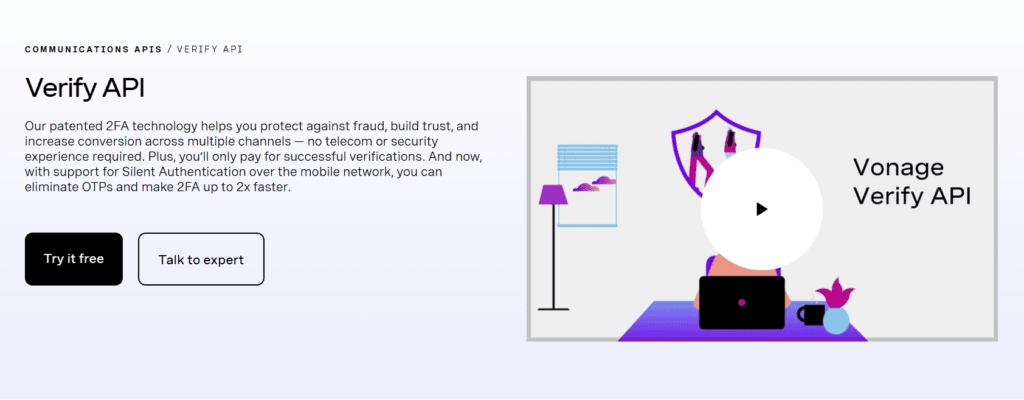
Vonage Verify is a strong option for businesses that want multichannel OTP delivery combined with built-in fraud prevention and verification optimization. It is part of Vonage’s broader communications API platform and is designed to simplify authentication flows while improving success rates through intelligent routing and channel selection.
Key Features
Multichannel verification (SMS, voice, WhatsApp, RCS, email, silent authentication)
Pay-per-successful verification model
Automatic channel fallback and failover logic
Built-in fraud prevention and risk controls
Silent authentication options (where supported)
Delivery tracking and reporting
Easy-to-integrate APIs and SDKs
Pricing
Vonage Verify typically uses a per successful verification pricing model, combined with channel-based costs depending on how the OTP is delivered. This approach can help align cost with outcomes, but total pricing still depends on geography, channel usage, and verification volume.
Pros and Cons
| Pros | Cons |
|---|---|
| Pay only for successful verifications | Pricing can vary depending on channel mix |
| Strong multichannel support | Can be more than needed for simple SMS OTP use cases |
| Built-in fraud prevention features | Requires API integration and setup |
| Automatic fallback improves delivery success | Platform can feel layered for smaller teams |
| Supports advanced methods like silent authentication | Not the simplest option for non-technical users |
Reviews
It has been 2 years i am using Vonage and its a very great app and very easy to use for calling & texting internationally. Capterra Review
Vonage Communications APIs are highly versatile and developer-friendly. I especially appreciate the ease of integrating voice, SMS, and video functionalities into applications without building complex infrastructure from scratch. G2 Review
5. Infobip
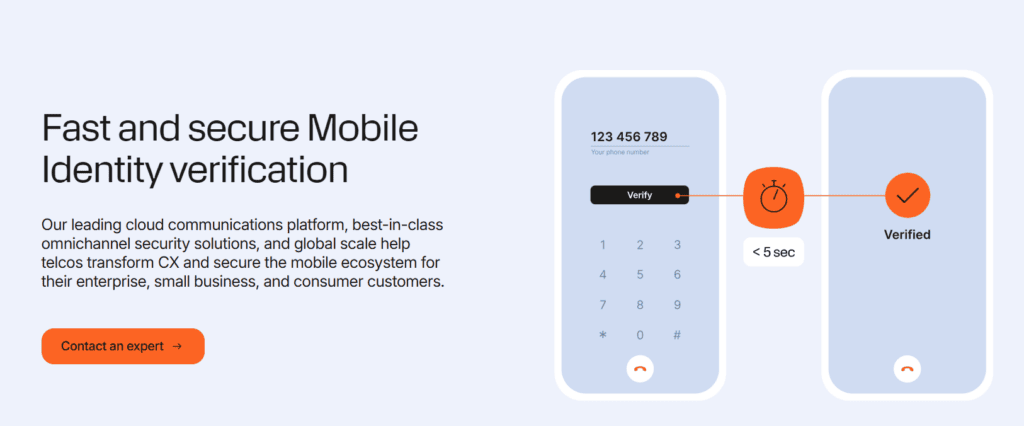
Infobip is a global communications platform built for businesses that need to handle authentication at scale across multiple regions. It is particularly strong in international messaging and enterprise communication, making it a solid choice for companies that operate globally and need consistent OTP delivery across different markets.
Key Features
Multichannel OTP delivery (SMS, WhatsApp, voice, email, push)
Global infrastructure with direct carrier connections
Advanced routing and delivery optimization
Two-way messaging support
Delivery tracking and analytics
Integration with broader communication workflows
Enterprise-grade scalability
Pricing
Infobip uses a usage-based pricing model that varies by country, channel, and volume. Pricing is often customized depending on the business and may require sales engagement, especially for high-volume or enterprise use cases. Costs can vary significantly depending on the regions you are targeting.
Pros and Cons
| Pros | Cons |
|---|---|
| Strong global coverage and delivery performance | More complex setup and onboarding |
| Good fit for high-scale authentication | Pricing is not always fully transparent upfront |
| Supports multiple communication channels | Often requires sales involvement |
| Advanced routing improves reliability | Can be overkill for smaller teams |
| Scalable enterprise infrastructure | Less focused on simplicity |
Reviews
My overall experience with Infobip is very good. I’ll recommend this to everyone. Capterra Review
So far quite smooth. No complaints is a good thing meaning it is stable. 🙂 Capterra Review
6. Plivo Verify
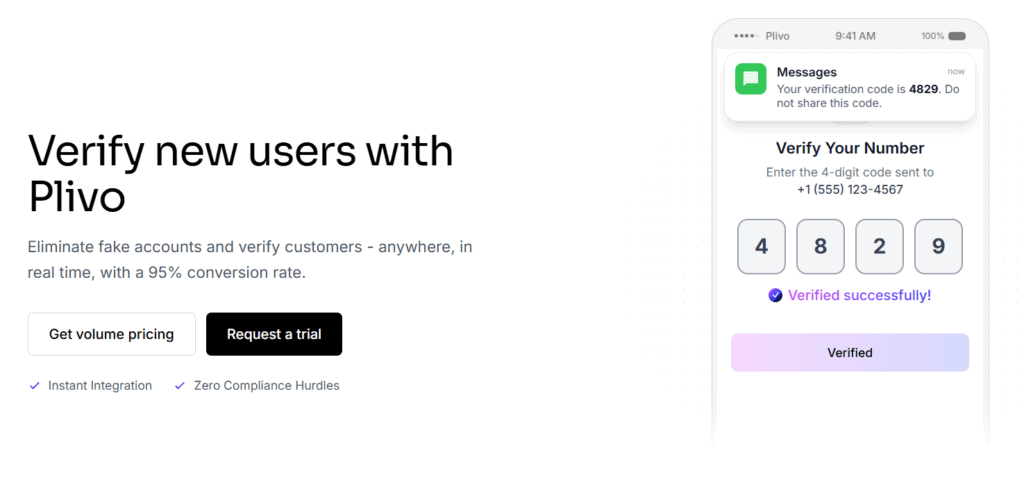
Plivo Verify is a strong option for businesses that want a cost-effective OTP API without sacrificing core verification capabilities. It is especially appealing for developer-led teams that need reliable authentication flows, global coverage, and straightforward pricing without the overhead often associated with larger platforms.
Key Features
Multichannel OTP delivery (SMS, voice, WhatsApp)
Verify API for authentication workflows
Fraud Shield for protection against suspicious activity
Delivery tracking and status updates
Simple API integration and developer-friendly structure
Global coverage for verification use cases
Scalable infrastructure for transactional authentication
Pricing
Plivo Verify is positioned as a cost-efficient solution, with no platform fee for verification itself. Businesses typically pay only for the channels used (SMS, voice, WhatsApp), which can make pricing easier to understand and more predictable compared to providers that charge per verification attempt or include additional platform costs.
Pros and Cons
| Pros | Cons |
|---|---|
| Cost-effective pricing model | Smaller ecosystem than larger providers |
| No platform fee for verification | Fewer advanced enterprise features |
| Simple and developer-friendly API | Less focus on multichannel sophistication |
| Includes fraud protection (Fraud Shield) | Limited brand recognition in some markets |
| Good global coverage | Not as feature-rich as enterprise platforms |
Reviews
I am utilizing the Plivo platform for school districts to help provide a more cost effective phone sharing option. It has been great but I think we will need to do a lot of the heavy lifting ourselves with managing the sub accounts (schools/customers). Capterra Review
What I like most about Plivo is the simplicity. You set it up quickly, it runs stably, and you don’t have to constantly deal with it – that’s exactly how I like it. G2 Review
7. Telnyx Verify
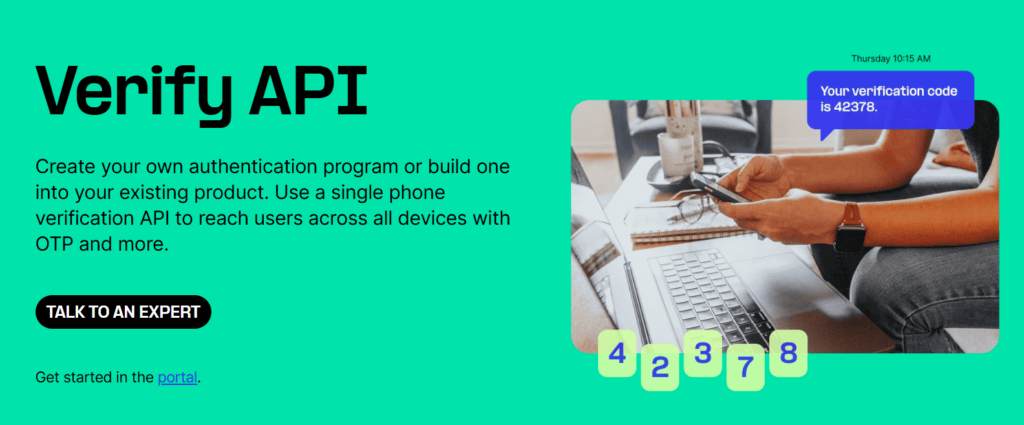
Telnyx Verify is a modern OTP API designed for technical teams that want more control, transparency, and flexibility in how they handle authentication. It positions itself as an alternative to larger CPaaS providers by offering programmable verification with clear pricing and infrastructure-level access.
Key Features
Multichannel OTP delivery (SMS, voice, flash call)
Programmable verification workflows
Delivery tracking and real-time reporting
Transparent pricing structure
Number management (local, toll-free, etc.)
API-first approach with strong developer control
Scalable infrastructure for authentication
Pricing
Telnyx uses a usage-based pricing model with a strong emphasis on transparency. Pricing is typically available per country and per channel, which helps businesses better estimate costs compared to providers that rely heavily on custom quotes. As always, total costs depend on geography, channel mix, and usage volume.
Pros and Cons
| Pros | Cons |
|---|---|
| Transparent and predictable pricing | More technical setup required |
| Strong control over verification workflows | Less beginner-friendly |
| Good alternative to large CPaaS providers | Smaller ecosystem compared to incumbents |
| Flexible and programmable platform | Requires more engineering resources |
| Supports multiple verification channels | Can feel infrastructure-heavy for simple use cases |
Reviews
My overall experience has been extremely positive. Telnyx provided the critical, scalable infrastructure that made our custom AI voice agent project feasible. Software Advice Review
The platform is very intuitive and easy to use. After verification, setting up numbers and configuring call forwarding was straightforward. I also value the security and compliance measures, which make the service very reliable for business use. Capterra Review
